
Curved home theater seating has become one of the most requested layouts for dedicated media rooms, and for good reason. Instead of lining recliners up in a flat row, a curved arrangement wraps the seats around the screen so every viewer is pulled into the picture. As a manufacturer, Linsen Seating builds curved rows in almost any configuration using wedge-shaped arms. This guide covers why a curve outperforms a straight row, when a straight row is still the better choice, and how to plan your own.
Curved vs Straight Theater Seating at a Glance
| Curved row | Straight row | |
| Viewing angle from end seats | Ends turn in towards the screen | Ends view the screen at an angle |
| Look | Custom-cinema centrepiece | Classic, expected |
| Conversation | Guests can see each other | Hard to talk end to end |
| Space | Needs more planning around width and depth | Most space-efficient |
| Best for | Rows of 3+ seats, large screens, wider rooms | Narrow rooms, short rows, tight budgets |
Why Choose a Curved Row?
1. Better viewing angles for every seat
In any row, the best view is from the middle. In a straight row, the seats at each end face the screen at an angle, so those viewers get a skewed picture and sit off the audio sweet spot. A curved row rotates the end seats inward, aiming them at the centre of the screen for a squarer, more comfortable view. The console arms still keep everyone a comfortable distance apart, so you gain better angles without giving up personal space.
2. A more striking room
A gentle arc gives the room an architectural, custom-cinema feel the moment you walk in, turning the seating from furniture into the centrepiece of the space. If you want your theater to feel designed rather than simply furnished, the curve does most of that work on its own.
3. A more social layout
In a straight row of five or six seats, the person at one end can barely talk to the person at the other. A curved row brings everyone into a shallow semicircle, so guests can see and talk to each other naturally. For families and anyone who hosts movie nights, the seating draws people together instead of lining them up.
4. Easy to mix with straight rows
Curved rows combine well with straight ones in larger or tiered rooms. A common setup places a curved row up front and a straight row of recliners behind it, raised on a riser for stadium-style sightlines. You get the drama of the curve where it matters most, with the simplicity of a straight row behind.
When a Straight Row Is the Better Choice
A straight row is the most common configuration because it uses space most efficiently. It is the better choice in narrow rooms, for rows of only two seats, or when the screen is modest and the end seats are not far off-centre. If you choose a straight row, keep it centred on the screen and avoid making it much wider than the screen, so the end seats still get a good view. For more layout options by number of seats, see our home theater seating layout guide.


Full Curve or Half Curve: How Wedge Arms Work
A curved row is built by replacing some or all of the straight armrests between seats with wedge-shaped arms, which are wider at the back than at the front. Each wedge turns the next seat slightly inward.
- Full curve: every arm between seats is a wedge, so the whole row forms a smooth arc.
- Half curve: only two or three arms are wedges, so part of the row curves and part stays straight. This saves space and helps fit awkward room shapes while keeping the curved look.
Almost any of our home theater recliners can be built this way, so you are not limited to dedicated curved models. Ask us which models in our range can take wedge arms.

Curved Seating Configurations
A common worry is that a curve only works for big rooms or long rows. It doesn’t: we build curves at almost any seat count, and the longer the row, the more pronounced the curve becomes. You can browse every model in our curved home theater seating collection.
2-seat curved seating
A two-seat curve is possible, but the arc is so slight that it looks much like a straight pair. For that reason we usually suggest starting the curve at three seats, where the shape becomes clearly visible.


A 2-seat curved row — subtle, but available on request.
3-seat curved seating
Three seats is where the curve really reads as a curve. It suits most mid-sized media rooms and is our most popular starting point. Two popular 3-seat curved rows:
- LS-876 curved home theater seating with console: large storage compartments in the middle arms, and shaped end arms that strengthen the curved look.
- LS-6106 3-seat curved theater seating with lifting console.

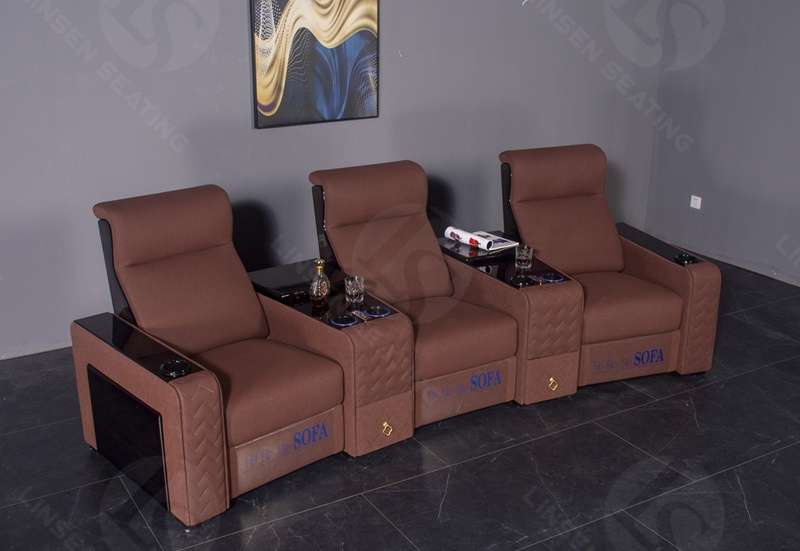
A 3-seat curved row — the most popular starting configuration.


4-seat curved seating
Four seats can be built as a full or half curve, which makes this size flexible for awkward room dimensions. Most of our models can be made into a four seats curved seating on request.


4-seat curved seating, available as a full or half curve.
5, 6 seats and beyond
Rows of five, six, seven, eight or more seats show off the curve best of all. The wider the row, the deeper the arc, which also means footrests never bump into each other when everyone reclines. The LS-805R 5-seat curved theater seating is a popular choice for wider rooms.

5-seat curved theater seating, full & half-curve options

5-seat curved seating, available as a full or half curve.

Planning a Custom Curved Row
Because we build to order, a curved row can be tailored to your room rather than squeezed into it. Before production, we settle four things with you:
- Room measurements: width, depth and features such as columns, doors and sloped ceilings. A curve changes both the width and the depth the row needs, so accurate numbers matter. Our home theater room size calculator gives a quick first estimate.
- Seat count and curve: how many seats, full or half curve, and the curve radius that suits your viewing distance.
- Consoles and features: storage or lifting consoles, power headrests, LED lighting and cooling cup holders.
- Upholstery and colour: leather, microfiber, suede or fabric, matched to the room.
Get a free CAD layout drawing. Send us your room size and the number of seats you need, and we will draw up a curved or straight layout for your room, then build the seating to the plan we agree on. As the manufacturer, Foshan Linsen Seating Furniture Co., Ltd. supports OEM and ODM projects and ships worldwide. Contact us to start your layout.
Frequently Asked Questions
It needs more careful planning rather than always more space. The ends of a curved row come forward, so the row takes more depth, and the wedge arms change its overall width. A layout drawing based on your room measurements shows exactly how it fits.
Usually, yes. A curved row is created by fitting wedge-shaped arms between the seats, so many standard home theater recliners can be built as a full or half curve.
Related Products:
 Why should you update your movie room chairs with power theater recliner?
How to preserve leather theater recliner
What Is the Best Home Theater Seating?
Best Cinema Chairs for Your Home 2023 – Cinema Chair Picking Guide
What Is The Average Life Of A Home Theater Recliner?
How To Place Speaker For Balanced Sound In Home Theater?